
Are you putting off your counseling career because of something you heard that may not even be true? Misinformation about substance abuse counselor certification stops thousands of qualified, passionate people from entering one of the most impactful careers in behavioral health. This guide busts the five biggest myths — and gives you the real, actionable truth.
What Is Substance Abuse Counselor Certification — and Why Does It Matter?
Substance abuse counselor certification is an official credential that qualifies you to provide counseling, support, and recovery coaching to individuals struggling with addiction, substance use disorders (SUDs), and co-occurring mental health challenges. Depending on your state and certification level, you can work in treatment centers, outpatient clinics, hospitals, community programs, and peer recovery settings.
According to the U.S. Bureau of Labor Statistics, substance abuse, behavioral disorder, and mental health counselors are projected to grow by 18% through 2032 — much faster than average. The demand is real, the need is urgent, and the pathway to certification is more accessible than most people think.
But myths and misconceptions keep too many people on the sidelines. Let’s change that.
Key Takeaways
- You do not need a 4-year college degree to start a career in substance abuse counseling
- Entry-level substance abuse training certification programs can be completed in weeks to months
- Peer counselor certification and peer recovery coaching are legitimate, credentialed career paths
- Most certifications are available online and designed for working adults
- Getting certified creates a clear career ladder — from entry-level roles up to licensed clinical counselor
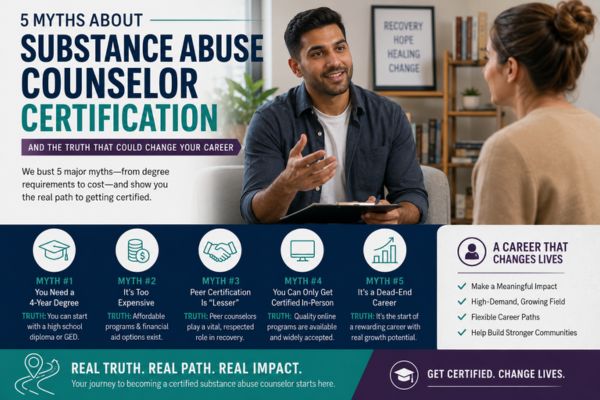
Myth #1: Do You Need a 4-Year Degree to Get Substance Abuse Counselor Certification?
No — many substance abuse counselor certification pathways require only a high school diploma or GED, especially for entry-level roles like Substance Abuse Counselor-in-Training (SAC-IT) and peer recovery coach.
This is the most damaging myth in the field. It prevents career changers, people in recovery, and community advocates from ever taking the first step. Here’s the truth:
The Reality of Degree Requirements
Substance abuse counselor certifications exist on a tiered credential ladder, and the entry rungs are far more accessible than most people realize:
- Peer Recovery Coach (PRC): No degree required. Built on lived experience with substance use or mental health challenges, plus approved training.
- Substance Abuse Counselor-in-Training (SAC-IT): Entry-level credential designed for people new to the field — no bachelor’s degree needed.
- Certified Alcohol & Drug Counselor (CADC I): Requires documented education hours and supervised experience, but many programs accept a high school diploma plus coursework.
- Higher-level licensure (CADC-II, LAC, LMHC): These do require a bachelor’s or master’s degree — but they are upper tiers you grow into, not starting requirements.
What You Actually Need to Start
- A high school diploma or GED
- Enrollment in an approved substance abuse training certification program
- Completion of required education hours (varies by state — often 40–315 hours)
- Documented supervised experience hours
- Passing a certification exam (for most credentials above entry level)
Myth #2: Is Substance Abuse Counselor Certification Too Expensive to Pursue?
Not at all — many entry-level drug and alcohol counselor training programs cost a fraction of a college degree, and some are available for under $1,000.
The assumption that certification = tuition debt is one of the biggest financial myths in behavioral health education. Here’s a realistic cost breakdown:
Real Costs vs. Perceived Costs
| Credential Level | Typical Cost Range | Time to Complete |
|---|---|---|
| Peer Recovery Coach Certificate | $200 – $800 | 2–8 weeks |
| SAC-IT (Counselor in Training) | $500 – $1,500 | 2–4 months |
| CADC-I Certification | $800 – $3,000 | 6–12 months |
| Bachelor’s Degree (for reference) | $40,000 – $120,000 | 4 years |
Ways to Reduce Your Certification Costs
- Employer tuition reimbursement: Many treatment centers and healthcare organizations pay for staff certification
- Scholarships and grants: SAMHSA and state health departments often fund substance abuse workforce training
- Online programs: Remote drug and alcohol counselor training eliminates commute and housing costs
- Sliding-scale academies: Some training providers, including peer coach academies, offer income-based pricing
The financial barrier to entry for substance abuse counselor certification is genuinely low — especially compared to the earning potential once you’re credentialed.
Myth #3: Is Peer Counselor Certification a “Lesser” Credential Than Clinical Certification?
Absolutely not — peer counselor certification is a distinct, respected, and growing credential category that serves a critical role that clinical counselors cannot always fill.
There is a harmful hierarchy in some circles that dismisses peer recovery roles as “not real counseling.” This is both inaccurate and costly to the healthcare system.
What Makes Peer Counselor Certification Uniquely Powerful
Peer counseling certification training prepares individuals to serve as recovery support specialists based on shared lived experience — something no clinical degree can replicate. Research consistently shows:
- Peer support specialists improve treatment retention rates
- Individuals in recovery are more likely to engage with certified peer counselors
- Peer recovery coaching reduces hospital readmission and relapse rates
- SAMHSA formally recognizes peer support as an evidence-based practice
The Peer Coach Academy Pathway
Programs offered through peer coach academies — like the LEARN Peer Recovery Coach (PRC) program at Laitinen Academy — prepare you to:
- Provide non-clinical recovery support and wellness coaching
- Work in treatment centers, hospitals, community health programs, and telehealth
- Serve as a credentialed member of integrated care teams
- Pursue advanced peer coach training and supervisor credentials over time
Peer counselor certification is not a consolation prize — it is a frontline, high-demand career path in its own right.
Myth #4: Can You Only Get Substance Abuse Counselor Certification In-Person?
No — the majority of approved substance abuse training certification programs are now fully available online, including coursework, exams, and peer coach training.
Before COVID-19 reshaped professional education, many people believed hands-on healthcare training had to be in-person. That era is over. Today, online certification is the norm, not the exception.
What Online Drug and Alcohol Counselor Training Covers
A quality online certification program for substance abuse counseling typically includes:
- Foundations of addiction and substance use disorders — biology, psychology, and social factors
- Counseling skills and techniques — motivational interviewing, CBT basics, trauma-informed care
- Ethics and professional standards — scope of practice, confidentiality, dual relationships
- Case management and treatment planning — assessment tools, documentation, referral processes
- Co-occurring disorders — understanding the relationship between mental health and addiction
- Cultural competency — serving diverse populations effectively
What to Look for in an Online Program
Not all online programs are equal. When evaluating substance abuse training certification options online, look for:
- State approval or accreditation — ensure the program is recognized by your state’s credentialing board
- IC&RC or NAADAC alignment — the two major national certification bodies
- Supervised hours guidance — the program should help you understand how to document clinical hours
- Instructor credentials — look for experienced counselors or licensed professionals leading coursework
- Flexible scheduling — quality programs accommodate working adults and caregivers
Myth #5: Is Substance Abuse Counselor Certification a Dead-End Career?
The opposite is true — substance abuse counselor certification is the beginning of a multi-stage career ladder with significant room for advancement, specialization, and salary growth.
Perhaps the most discouraging myth is the idea that getting certified puts you in a low-paying, limited role forever. The data tells a completely different story.
The Substance Abuse Counselor Career Ladder
Here is what a realistic career progression looks like, starting from peer counseling certification training:
Stage 1 — Entry Level (No Degree)
- Peer Recovery Coach (PRC)
- Substance Abuse Counselor-in-Training (SAC-IT)
- Behavioral Health Technician
- Salary range: $30,000 – $42,000
Stage 2 — Certified Counselor
- Certified Alcohol & Drug Counselor I (CADC-I)
- Registered Alcohol/Drug Technician (RADT)
- Salary range: $40,000 – $55,000
Stage 3 — Advanced Certification
- CADC-II
- National Certified Addiction Counselor (NCAC)
- Salary range: $50,000 – $70,000
Stage 4 — Licensed Clinical Counselor (degree required)
- Licensed Professional Counselor (LPC)
- Licensed Clinical Social Worker (LCSW)
- Licensed Mental Health Counselor (LMHC)
- Salary range: $65,000 – $95,000+
Specialization Opportunities Along the Way
As you advance, you can specialize in areas that increase your value and earning potential:
- Adolescent and youth substance abuse counseling
- Trauma-informed and PTSD-focused recovery support
- Co-occurring disorder counseling
- Criminal justice and re-entry counseling
- Telehealth and digital recovery coaching
- Supervision and peer coach training facilitation
Your substance abuse counselor certification is not a ceiling — it is the foundation of a career that can grow as far as your ambition takes it.
How to Get Started With Substance Abuse Counselor Certification at Laitinen Academy
Laitinen Academy offers flexible, accessible, and state-aligned certification programs for people ready to enter the behavioral health field — with or without a traditional college background.
Available Programs:
- Peer Recovery Coach (PRC) — LEARN Program: Entry-level certification built on lived experience and peer coach training, with no degree required
- Substance Abuse Counselor-in-Training (SAC-IT): Foundational drug and alcohol counselor training for new professionals
- Substance Abuse Counselor Certification: Advanced coursework for those pursuing CADC-level credentials
Why Choose Laitinen Academy?
- Fully online and self-paced — study around your life
- Programs aligned with IC&RC and national standards
- Real-world curriculum taught by experienced professionals
- Supportive community of peers and instructors
- Clear next-step guidance for continuing your career
Frequently Asked Questions (FAQ)
Can I get substance abuse counselor certification if I am in recovery myself?
Yes — and your lived experience is genuinely an asset, not a barrier. Peer counselor certification programs are specifically designed for people with lived experience in recovery. Your personal journey can make you a more effective, credible, and empathetic counselor for the people you serve.
What is the difference between a peer coach academy and a clinical counselor program?
A peer coach academy — like those offering LEARN PRC or similar credentials — prepares you for non-clinical recovery support roles based on shared experience and coaching skills. Clinical counselor programs prepare you for diagnostic and therapeutic roles. Both are valuable; many professionals start in peer coaching and later pursue clinical credentials.
Is online drug and alcohol counselor training accepted by employers?
Yes. Online programs that are accredited, state-approved, and aligned with IC&RC or NAADAC standards are widely accepted by employers, including hospitals, treatment centers, community health organizations, and government agencies. Always verify that the program you choose meets your state’s specific requirements.
How much can I earn with a substance abuse counselor certification?
Entry-level roles typically pay between $30,000 and $45,000 per year. With additional certification and experience, mid-level counselors earn $50,000–$70,000. Advanced licensed professionals can earn $80,000–$95,000 or more, particularly in clinical supervision, private practice, or specialized treatment settings.
What is peer coach training, and is it the same as peer counseling certification?
Peer coach training is the educational preparation you complete before earning a peer counselor certification. The training covers recovery support principles, communication skills, ethical boundaries, wellness planning, and how to connect clients to services. Upon successful completion, you receive your peer counselor certification — the official credential.
Final Thoughts: Don’t Let Myths Cost You a Meaningful Career
Substance abuse counselor certification is one of the most accessible, impactful, and financially sound career moves in behavioral health today. The myths explored here — about degree requirements, costs, credibility, online learning, and career limits — are simply not supported by the facts.
The real barrier isn’t your background, your budget, or your educational history. It’s the misinformation that keeps motivated people from taking the first step.
If you’re ready to build a career helping others reclaim their lives from addiction, Laitinen Academy’s substance abuse counselor certification and peer coach training programs are designed to take you from where you are today to where you want to be.